Physical Address
304 North Cardinal St.
Dorchester Center, MA 02124
Physical Address
304 North Cardinal St.
Dorchester Center, MA 02124

The Silent Financial Programming You Never Knew You Had Close your eyes for a second. Think back to your childhood. Do you remember what your parents said about money? Did they fight over bills? Did they whisper about debt? Or did money just… never get talked about at all? Whatever happened in that house — it’s still happening inside you. Right now. Today.

Every single person walking this earth has what experts call a financial blueprint.
It’s not something you chose. It’s not something you built. It was handed to you — quietly, invisibly — during the first years of your life.
Think of it like a house. Before you move any furniture in, before you hang a single picture — someone already built the walls, laid the foundation, and decided which way the doors open.
That’s your childhood.
And whether your parents were rich, poor, generous, fearful, silent, or chaotic about money — they were building your financial foundation brick by brick.
The scary part? Most people never question that foundation. They just live inside it. Year after year. Wondering why the house never feels right.
Here’s something that will change how you see your own money habits forever.
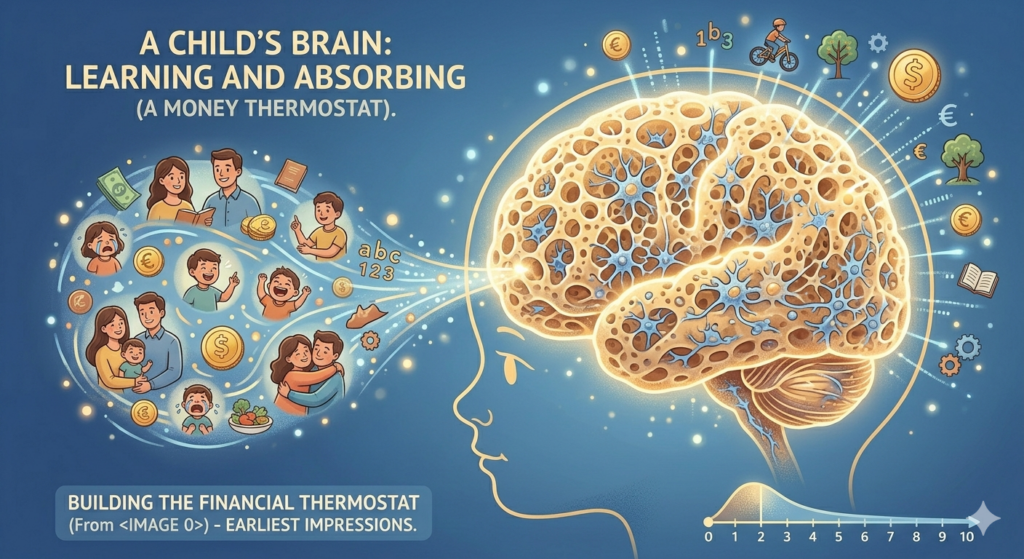
Between the ages of 0 and 7, the human brain operates primarily in a state called theta brainwave activity. This is the same state adults enter during hypnosis.
What does that mean?
It means a young child’s brain has no critical filter. No ability to say “wait, is that actually true?”
Everything just goes straight in.
Every argument your parents had about rent. Every time someone said “we can’t afford that.” Every look of shame when the credit card was declined. Every celebration when a bonus came in.
Your young brain absorbed all of it — not as stories, but as facts. As truth. As reality.
And then life moved on. You grew up. You forgot about those moments.
But your subconscious mind? It never forgot. It’s been running those programs every single day since.
“Give me a child until he is 7 and I will show you the man.” — Aristotle
Aristotle said this thousands of years ago. Modern neuroscience is just now proving how right he was.
Let’s get specific. Because this isn’t just theory — this is your actual life.
Or more accurately — the way they didn’t talk about it.
There are three kinds of money households:
The Silent House Money was never discussed. It was a private, almost shameful topic. Kids were kept out of financial conversations completely.
Result: Adults who feel anxious and avoidant about money. They don’t open bills. They avoid checking their accounts. They never talk about finances with their partner. Because silence was the lesson — and they learned it well.
The Stressed House Money was always a source of tension. Arguments, sighs, worry, panic.
Result: Adults who associate money with conflict and pain. They either avoid earning more (to avoid the stress they associate with it) — or they become obsessed with controlling every penny out of fear.
The Open House Money was discussed calmly and honestly. Kids saw budgets, savings goals, and financial planning as normal parts of life.
Result: Adults with a healthier, more balanced relationship with money. Not perfect — but far more grounded.
Which house did you grow up in?
Children are not just listeners. They are watchers.
Long before you understood words, you were studying behavior. And what you saw your parents do with money became your default manual.
Did your father spend every paycheck immediately? You might struggle to save.
Did your mother hide money from your father? You might have a habit of financial secrecy in relationships.
Did your parents invest, plan, and talk about the future with excitement? You probably feel more comfortable building wealth.
This is called behavioral modeling — and it’s one of the most powerful forms of learning humans experience.
You didn’t choose to copy these patterns. Your brain copied them automatically — the same way a child learns to walk by watching others walk.
Here’s a powerful exercise:
Write down 3 money behaviors your parents had. Then honestly ask yourself — which of those do I still do today?
The answer might surprise you.

“You’re so bad with money.” “Stop being so greedy.” “You don’t need that — we’re not like those people.” “Money doesn’t matter as long as we have each other.”
Words are powerful. But words spoken to a child — during those early theta brainwave years — are not just words.
They become identity.
If you were told repeatedly that you were “bad with money” — your subconscious filed that under who I am. And your whole life, it has been quietly working to confirm that identity.
Because the subconscious mind doesn’t want to be wrong. It will sabotage opportunities, avoid financial education, and make careless decisions — all to prove the label right.
This is called identity-based programming — and it’s one of the hardest money blocks to break, because it feels deeply personal.
The truth: You were not born with money skills or without them. You were given labels that became beliefs that became behaviors.
Labels can be removed. New ones can be written
Not all childhood money programming is slow and gradual.
Sometimes it arrives in a single, powerful moment.
The day the electricity got cut off. The night you heard your parents cry about losing the house. The Christmas where there were no gifts. The moment you were made fun of at school for your clothes.
These moments create what psychologists call financial trauma — and they leave marks that last decades.
Financial trauma can look like:
If you experienced financial hardship as a child, your nervous system learned: money = danger. And now, as an adult, your body still reacts the same way — even when the actual danger is long gone.
Healing financial trauma isn’t just a mindset exercise. Sometimes it requires real, deep emotional work.

Some of the most powerful childhood money programming didn’t come from dramatic moments.
It came from throwaway phrases said hundreds of times around the dinner table.
Do any of these sound familiar?
None of these phrases were meant to harm you. They were said casually, even lovingly.
But repetition is how the subconscious learns. And you heard these phrases hundreds — maybe thousands — of times.
Here’s a concept that will explain so much of your financial history.
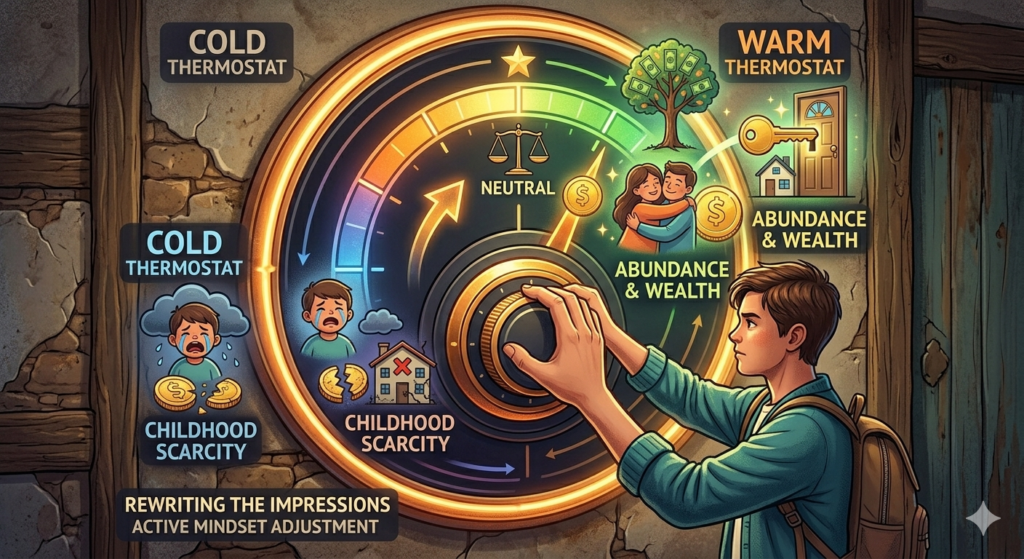
Every one of us has an internal money thermostat — a subconscious “set point” for how much money we feel comfortable having.
This set point was determined in childhood.
And just like a real thermostat — if the temperature in the room gets too high or too low, it automatically adjusts back to the “normal” setting.
This is why:
Your subconscious doesn’t care about logic. It cares about what feels normal.
If you grew up in a household where struggle was normal — struggle will feel comfortable to you. Abundance will feel wrong.
And when things start going too well financially, your internal thermostat will kick in: creating problems, finding ways to spend, making bad decisions — all to bring things back to “normal.”
The only way to permanently change your financial situation is to raise your money thermostat.
And that means going back to where it was set — your childhood — and doing the work to reset it.
Here’s something even deeper.
Your money blocks didn’t just come from your parents’ words and actions. They may have come from their childhood. And their parents’ childhood. And their parents’ parents.
This is called generational financial trauma — and it’s more common than most people realize.
Think about it this way:
Your grandparents may have lived through extreme poverty, war, famine, or economic collapse. Their relationship with money was shaped by genuine survival fear.
They passed those fears to your parents — who passed them to you.
You might be carrying financial anxiety from an economic crisis that happened decades before you were born.
You didn’t cause those patterns. You inherited them.
But here’s the powerful truth: you can be the one who breaks the cycle.
You can be the first person in your family line to have a healthy, abundant relationship with money. And when you do — you pass that new pattern forward to your children.
That’s not just personal healing. That’s generational healing.
Awareness is the beginning. But awareness without action is just interesting information.
Here’s how to actually start changing the childhood programming that’s been running your finances:
Sit with a journal and answer these honestly:
Don’t rush this. Let the memories come. They are the map to your blocks.
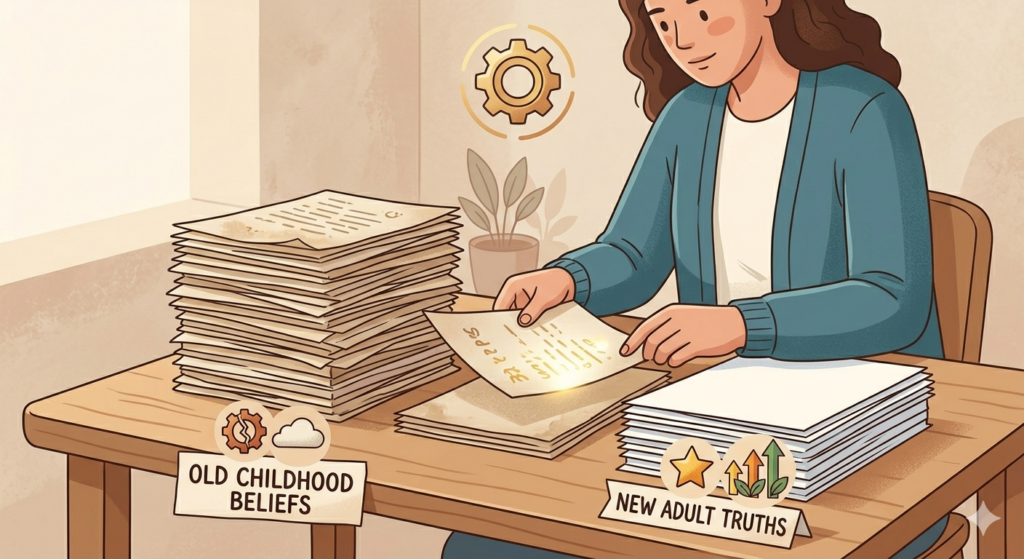
Take each belief you uncovered and examine it like a detective.
“Rich people are greedy.” — Is that actually true? Are ALL wealthy people greedy? Can you think of even one exception?
“There’s never enough money.” — Was that true for your family then? Is it actually true for you today?
Most childhood money beliefs cannot survive honest examination. They were formed by a child’s limited brain — not an adult’s full understanding of the world.
This is the step most people skip — and it’s often the most important.
If you grew up without financial security, without education about money, without a sense that abundance was possible for someone like you — that’s a loss worth grieving.
You deserved better financial guidance. Many of us didn’t get it.
Acknowledging that pain — without blame, without bitterness — creates space for healing. And healing creates space for change.
Here’s a reframe that many people find incredibly healing:
Imagine the version of you as a child who absorbed all those money fears. That child is still inside you.
Now — what would you tell that child today?
“Money is safe.” “There is enough.” “You are worthy of abundance.” “You don’t have to be afraid.”
This isn’t just poetic. It’s a real psychological practice — reparenting your inner child — and it genuinely rewires the emotional programs formed in childhood.
Your subconscious learns from repetition and experience — not just thoughts.
So give it new experiences:
Every positive financial experience is a new data point. Over time, those data points build a new story — one that says: money is safe, money flows, I am capable.
Let’s end with the biggest picture of all.
The work you do on your money mindset doesn’t just change your bank account.
It changes the childhood that your children will have.
Because if you do this work:
You might be doing this work for yourself. But the people who will benefit most — are the ones who haven’t been born yet.
That’s the real return on investment.

Your childhood shaped you. But it does not define you.
The beliefs you absorbed before you were old enough to question them — they were never really yours. They were borrowed. Inherited. Absorbed without consent.
You are allowed to give them back.
You are allowed to build a new relationship with money — one based on truth, not fear. On possibility, not limitation. On who you are becoming, not who you were told you were.
The financial story of your childhood already happened.
The financial story of your future? That one — you get to write.
Did this article hit close to home? Drop a comment below and share one money belief from your childhood that you’re ready to release. And if someone you know is stuck in old financial patterns — share this with them. It might be exactly what they needed to read today.