Physical Address
304 North Cardinal St.
Dorchester Center, MA 02124
Physical Address
304 North Cardinal St.
Dorchester Center, MA 02124

Have you ever wondered why some people seem to attract money effortlessly — while others work twice as hard but never get ahead? The answer might not be in your bank account. It might be hiding deep inside your mind.

Let me tell you about Sarah.
Sarah was smart. She had a good job, worked long hours, and always tried to save money. But every time her bank account started growing — something would happen. A sudden expense. An impulse purchase. A “too good to miss” investment that failed.
She couldn’t figure it out.
Until one day, her therapist asked her a simple question:
“What did your parents say about money when you were growing up?”
Sarah paused. Then she remembered.
“Money doesn’t grow on trees.” “Rich people are greedy.” “We can’t afford that.”
Those words — heard hundreds of times as a child — had become her truth. They weren’t just memories. They had become programs running silently in her subconscious mind.
That’s exactly what a subconscious money block is.

Here’s something most people don’t know:
95% of your daily decisions are made by your subconscious mind. Not your logical, thinking brain — but the deep, automatic part that runs on old programming.
Think of it like this:
Your conscious mind is the driver of a car. Your subconscious mind is the GPS — and it was programmed years ago.
If that GPS has the wrong destination saved, it doesn’t matter how hard you drive. You’ll keep ending up in the wrong place.
“Until you make the unconscious conscious, it will direct your life and you will call it fate.” — Carl Jung
This is why:
It’s not bad luck. It’s bad programming.

Let’s break down the most common money blocks people carry — without even knowing it.
This is one of the most painful and common blocks.
Maybe someone told you that you weren’t smart enough. Maybe you grew up watching your family struggle and it felt wrong to want more. Maybe religion taught you that wanting money was selfish or sinful.
Whatever the source — the result is the same:
Deep down, you believe you don’t deserve wealth.
So your subconscious mind makes sure you never get it.
Signs you have this block:

This one comes from religion, culture, and family stories.
Growing up, many of us heard things like:
And here’s the problem — your subconscious mind loves you. It wants to protect you. So if it believes that money will make you a bad person, it will do everything in its power to keep money away from you.
It’s not punishing you. It’s protecting you — from the thing it was told is dangerous.
This is why some good-hearted, generous people stay broke their whole lives.
Key Insight:
Money is not evil. Money is a tool. A hammer can build a home or break a window — it depends on who holds it.
This is the scarcity mindset — and it’s deeply contagious.
If you grew up in a home where money was always tight, where conversations about money were always stressful, where the phrase “we can’t afford it” was a daily reality — you absorbed that energy.
Now, even if you earn good money, you still feel poor.
You might:
The scarcity mindset tricks your brain into thinking the financial pie is limited — and that there’s not enough for everyone.

In many families — especially in South Asian and conservative cultures — money is a taboo topic.
You don’t discuss salaries. You don’t ask what things cost. You don’t talk about debt. You don’t negotiate your worth.
This silence is deadly for your financial growth.
Because if you can’t talk about money, you can’t:
Silence around money = stagnation with money.
This is an identity block — and it’s one of the sneakiest ones.
At some point in your life, you made a few bad financial decisions. Maybe you spent your savings on something foolish. Maybe you got into debt. Maybe someone told you that you were “bad with money.”
And you believed them.
Now it’s become part of your identity. “I’m just not a money person.”
But here’s the truth:
Money management is a skill. Skills can be learned.
No one is born “bad with money.” You were just never taught. There’s a big difference.

Wait — isn’t hard work good?
Yes. But this belief becomes a block when it turns into:
“Money only comes through struggle.” “If it’s easy, it must not be real.” “I should feel exhausted to deserve my paycheck.”
People with this block:
Money doesn’t have to be hard. Ease is allowed.
This block creates a permanent wall between you and wealth.
It says: wealth is for other people. Special people. Lucky people. But not me.
This belief makes you a spectator of other people’s success instead of a participant in your own.
You scroll through success stories thinking “must be nice” instead of asking “what did they do and how can I learn from it?”
Luck exists — but it’s rarely the whole story.
Understanding where money blocks come from is the first step to healing them.
Between ages 0–7, your brain is essentially a sponge. You absorb everything — emotions, beliefs, patterns — without filtering.
Whatever your parents believed about money, you likely inherited.
Not because they were bad parents. But because beliefs transfer like viruses — silently and automatically.
Your culture shapes your relationship with money more than you realize.
Some cultures celebrate wealth. Others shame it. Some teach that suffering is noble. Others teach that ambition is greedy.
None of these are absolute truths. But they feel like truth when you’ve heard them your whole life.
A business failure. A bankruptcy. A theft. A financial betrayal.
One powerful negative experience can create a money block that lasts decades.
Your brain learned: “money causes pain” — and now it avoids it.
The people around you matter more than you think.
If everyone in your circle believes money is hard to get, that belief will feel like reality to you too.
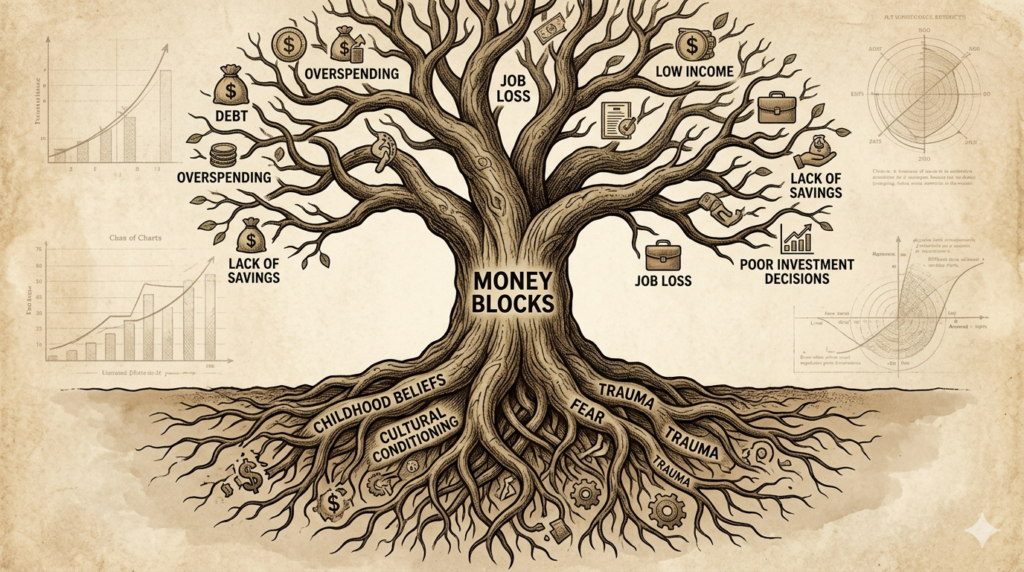
Before you can break a block, you need to find it.
Here are some powerful exercises:
Grab a journal. Finish these sentences without thinking too hard:
Your first instinct answers are the truth. They reveal your programming.
For one week, notice how you feel about money:
Anxiety, shame, guilt, anger — these are clues pointing to your blocks.
Look at your financial history like a detective:
Patterns don’t lie. Your subconscious leaves fingerprints everywhere.
Now — the part you’ve been waiting for.
Breaking money blocks is not about repeating affirmations in the mirror and hoping for the best. It’s about rewiring deep patterns at the root level.
Here’s how:
You can’t fight what you can’t see.
Once you identify a specific belief — say, “I don’t deserve to be rich” — write it down. Say it out loud. Acknowledge it as a belief, not a fact.
This single step creates powerful distance between you and the block.
Ask yourself:
Most money blocks fall apart under honest questioning. They were never based on facts. They were based on fear, pain, or someone else’s limited experience.
Replace the old belief with a new, truthful one.
Not a fantasy. A new truth you can actually believe.
Old belief: “Money is evil.” New truth: “Money is a tool. I can use it to do good.”
Old belief: “I don’t deserve wealth.” New truth: “I am allowed to receive abundance. My needs and desires matter.”
Write your new beliefs down. Read them daily. Repetition is how the subconscious is reprogrammed.

Beliefs only stick when they’re backed by action.
Start small:
Each small action sends a message to your subconscious: “This new belief is real. We live here now.”
You cannot outgrow the beliefs of the room you’re in.
Surround yourself with:
Your environment is constantly reprogramming you — make sure it’s programming you in the right direction.
Some money blocks are tied to deep trauma. Journaling alone won’t fix them.
Consider:
There’s no shame in getting help. The most successful people in the world have coaches and therapists.
Here is perhaps the most important thing in this entire article:
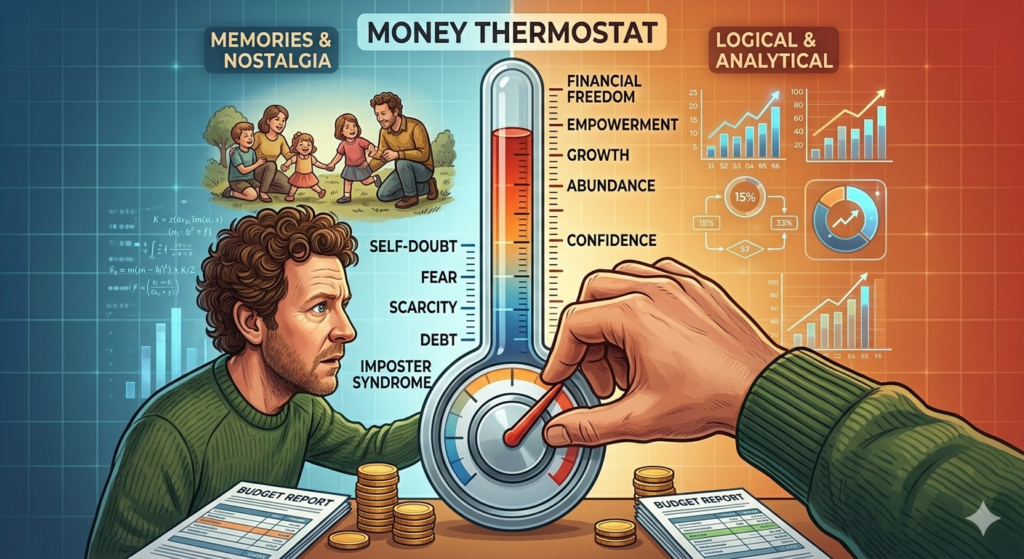
Your outer wealth will rarely exceed your inner sense of worth.
Read that again.
If deep down you believe you are worth $30,000 a year — your actions, decisions, and opportunities will naturally align to produce exactly that. No more.
This isn’t mystical. It’s psychology.
When you don’t feel worthy of wealth:
Increasing your self-worth is not a luxury. It is a financial strategy.
Story 1: The Freelancer Who Tripled Her Income
Amara was a graphic designer who always charged less than her competitors. She told herself it was to “be accessible.” But in therapy, she discovered the real reason: she didn’t believe her work was worth more.
Once she identified that block, she raised her rates — terrified. Three clients left. But five better ones arrived, willing to pay her new price.
In one year, her income tripled. Nothing changed about her skills. Everything changed about her belief.
Story 2: The Man Who Kept Losing Money
David made good money as an engineer. But every few months, something would wipe out his savings. A bad investment. An emergency. A business idea that failed.
Working with a financial coach, he uncovered a childhood belief: “having more than others is selfish.”
He had been unconsciously giving money away or losing it to avoid feeling like “one of those greedy rich people.”
Once he saw the pattern, he could break it. Within two years, he had his first $50,000 saved.
| Symptom | Likely Block | First Step |
|---|---|---|
| Always broke despite good income | Scarcity mindset / self-sabotage | Track spending + journal triggers |
| Undercharging for your work | “I don’t deserve more” | Write your value, raise rates by 10% |
| Avoiding checking bank account | Money anxiety / shame | Daily 2-minute money check-in |
| Guilt around spending on yourself | Unworthiness block | Practice intentional self-investment |
| Relationships suffer over money | Communication block | Open money conversation with partner |
| Sudden windfalls always disappear | Money thermostat too low | Set specific savings goals immediately |
You’ve spent your whole life being told that wealth is about what you do.
Work harder. Save more. Invest smarter.
And yes — those things matter.
But underneath all of it is something more fundamental:
What do you believe you deserve?
Because your actions will always — always — follow your beliefs.
The good news is this: beliefs can change. Your subconscious mind is not fixed. It was programmed once, and it can be reprogrammed.
The work is not easy. It’s not quick. But it is possible.
And it starts with one honest question:
What story am I telling myself about money — and is that story actually true?

If this article hit home for you — share it with someone who needs to hear it. And drop a comment below: what’s the one money belief you’re ready to let go of?